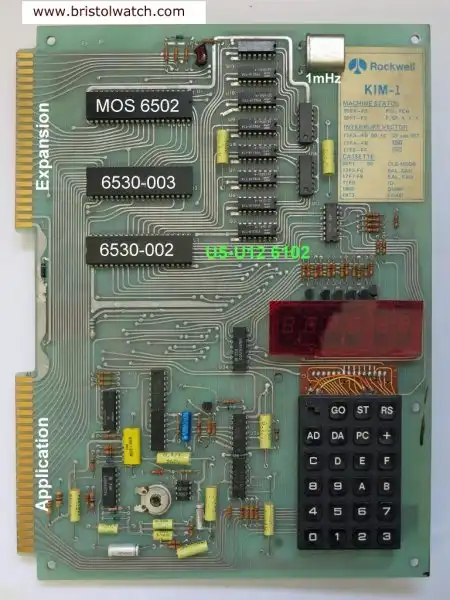
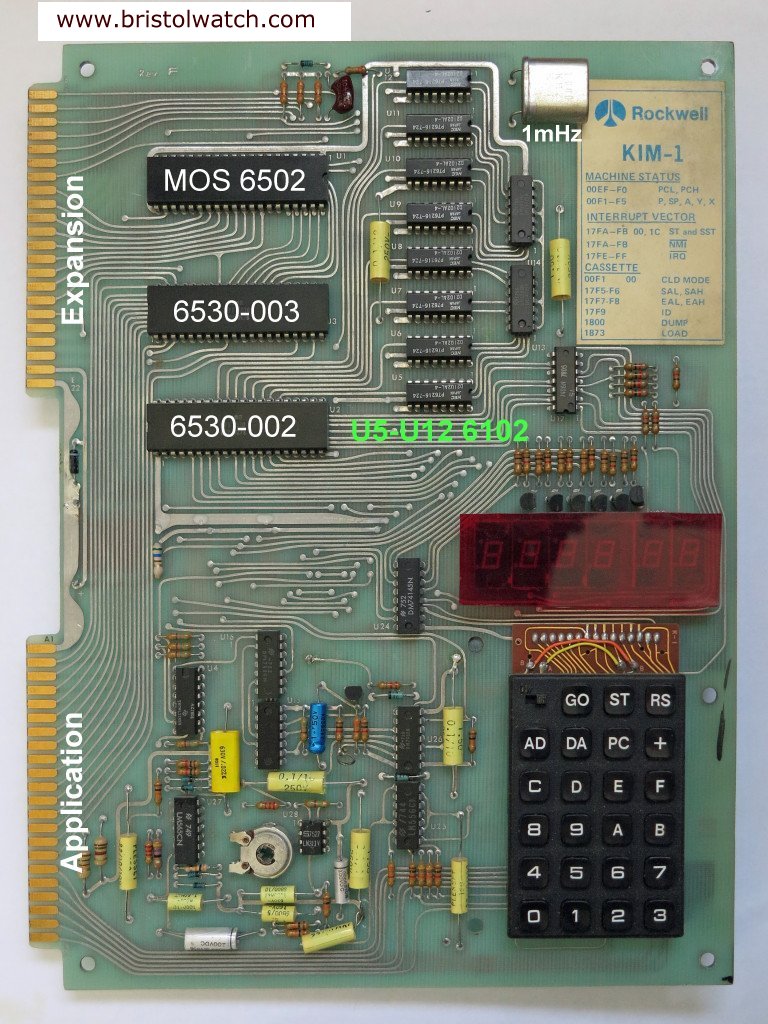
Fig. 1 Click For Larger Image
KIM-1 My First Computer
Updated 2022. Kim-1 alive in 2022 and is better than ever. I will start with a brief description, then update to modern development. The KIM-1 introduced the 6502 micro-processor, which is still used today and making a comeback.
The KIM-1 led the way to an affordable, easy-to-use computer-electronics foundation for hobby users. It is the direct ancestor to the Commodore C64, VIC-20, Atari 800 computers, and game consoles such as the Atari 2600, Apple II, PET, British Acorn, Ohio Scientific, etc.
KIM-1 programs, schematics, etc. are still available today. So modern versions can draw on a vast wealth of prior information. The modern CMOS 65C02 and related parts are still produced today and are a direct plug-in replacement for the earlier MOS 6502.
To quote another source,
...the 6502 (or variations thereof) formed the heart of many popular video game consoles and computers, such as the Atari 2600, Atari 8-bit family, Apple II, Nintendo Entertainment System, Commodore 64, Atari Lynx, BBC Micro, and others.
The KIM-1 started it all and in my view is the best way to learn computer electronics. As I understand KIM-1 clones are being used on some colleges.
The Commodore VIC-20 would be the first home computer to sell over 1 million units. Commodore bought MOS Technologies in 1976 and thus the KIM-1.
The KIM-1, short for Keyboard Input Monitor, is a small 6502-based computer developed and produced by MOS Technology, Inc.
The 6502 microprocessor had a purchase price of $25 in 1975. The KIM-1 was introduced in 1976.
The price of the rival Intel 8080 and Motorola 6800 was $375.00 in 1975.
The KIM-1 cost $240 ($1,265.65 in 2022) in 1975. Mine cost $220 in 1978. Mine has the Commodore logo.
MOS Technology was an integrated circuit or IC maker, not a computer manufacturer. The KIM-1 was designed to showcase their new 6502 microprocessor.
A group of 8 engineers left Motorola to design a better, more affordable version of the 6800. The 6502 introduced a more rational almost RISC (reduced instruction set computer) instruction set with simple hardware interfacing.
The KIM-1 consisted of a single printed circuit board with all the components on one side. It included three main ICs; the MCS6502 CPU, and two MCS6530 Peripheral Interface/Memory Devices.
While program-wise the 6502 is incomputable with the Motorola 6800, many of it's peripheral ICs are nearly identical with the 6800 series hardware.
The MCS6530 "is comprised of a mask programmable 1024 byte x 8 ROM, a 64 x 8 RAM, two 8 bit bidirectional ports ... and a programmable interval timer..." The KIM-1 brochure said "1 K BYTE RAM" The memory was composed of eight 2102 static RAM (1024 x 1 bit) and the two X 64 bytes of RAM in the MCS6530s.
The 2048 byte operating system was manufactured into the two 6530 ICs. One was labeled 6530-002; the other 6530-003.
This was a huge problem because few were made and are rare to find today. The original units (40-pin DIP) were ceramic, later units including my KIM-1 black plastic.
Later "clone" KIM-1s replaced the 2 internal 6530 ROMs (read-only memory) with a single 2K 2716 EPROM or 2K 2816 EEPROM. The 6530 RAM/IO/Timers were replaced with 6532 RIOTs.
Also included were six 7-segment LED displays (like on a calculator) and a 23-key calculator-type keypad. It was programmed in Hexadecimal. Many of the pins of the I/O portions of the 6530s were connected to the 44-pin application connector on the edge of the board (lower left), where they could be used as a serial system for driving a TTY 33-ASR (teletype terminal, and paper tape reader/punch).
One of these connector pins was a 12-volt power supply connector, and included analog lines that could be attached to a cassette tape recorder. (Required 12 volts to operate the LM311.)
The KIM-1 was one of the first single-board computers, needing only an external power supply to enable its use as a stand-alone experimental computer. This fact, plus the relatively low cost of getting started, made it quite popular with hobbyists through the late 1970s.
My keypad wore out and there's no replacement available. I use a modern clone version of the KIM-1 with a terminal program such as PUTTY under Windows or Linux.
More on that later.
Again, we must note the high cost of hardware at this time. A friend owned an Apple 2 and spent over $600 for 16K of RAM. And that was cheap.
To quote another source:
The KIM-1 was created in 1975 by Chuck Peddle as a development board for the new MOS 6502 microprocessor. The targeted users were engineers, but it turned out that hobbyist users were buying the KIM-1, not engineers. What made the KIM-1 so appealing to average hobbyists? At first glance, it has only 6 digit display, a mere 23 button keypad, and only 1K of RAM. By today's standards, most MP3 players are 100 times more powerful.
But back in 1976, it was a feature packed board for on $245. It also included a TTY interface to attach a terminal or paper tape. A cassette interface was also included when connectors were attached to the expansion connector giving mass storage to this powerful board.
The other feature the KIM-1 had was expansion connectors to connect real world devices such as switches, lights and speakers. With all of these features built into a board selling for half the price of most computer systems, it quickly became a very popular computer.
This by the way was not a toy. What was really great was it took talent and hard work to learn how do things with limited technical resources. Entire books and numerous programs were written around the KIM-1 and many of us in electronics got our hands on our first real computer. So:
Released: 1976
Price: US $245
CPU: MOS 6502, 1MHz
RAM: 1024 bytes
Display: 6 digital LED display
Input: on-board hexadecimal keypad
Ports: edge connector with 30 digital I/O lines
Storage: optional cassette recorder
OS: machine code (HEX)
Note there are versions of BASIC that work on the KIM-1 including the clone I use today. This includes full, floating point math and trig functions.
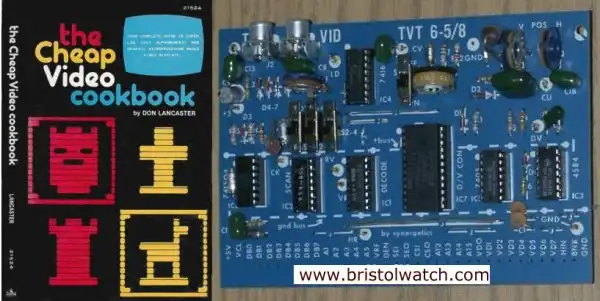
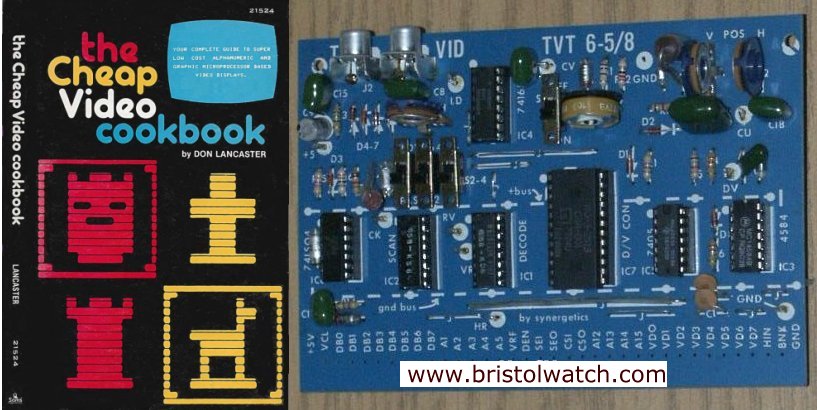
Fig. 2 Click For Larger Image
Cheap Video for the KIM-1
Note that I bought this. It came as a kit I had to solder together. It worked as advertised but meant a lot of hacking and soldering on my KIM-1.
To quote,
The designer of the TV Typewriter, Don Lancaster, developed this low cost video display for the KIM-1. The add-on board would display up to 4000 characters on a TV or monitor.
A typical configuration would be 16 lines of 32 upper case only characters. The board had only 10 low cost ICs and used the KIM's memory for the screen storage. The TVT-6 project appeared on the cover on Popular Electronics in July 1977.
The complete kit could be ordered from PAIA Electronics for $34.95. Don expanded this design to do color and simple graphics in The Cheap Video Cookbook.
Note this is not available today. The company https://paia.com/ still sells audio equipment as it did back then.
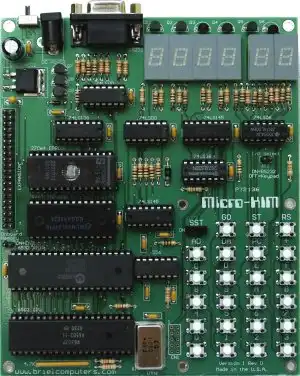
Fig 3 The Micro-Kim
The Micro-KIM
Note the Micro-Kim is no longer sold. The website is still up as of March 2022. The technical data and CD contain a wealth of usable information.
There is some Chinese knock-off claiming to use "recycled" parts. I don't trust them stay away from them.
They claim, "The micro-KIM uses many of the same components as the KIM-1 to give it that authentic vintage feel."
Not true. It does emulate the KIM-1, but the hardware really differs. The custom 6530-002 and 6530-003 RRIOTs have been replaced by a 2716 EPROM and a single 6532 RIOT.
Thus, the 16-20 programmable IO lines from the KIM-1 application connector don't exist on the MICRO-KIM. That requires the purchase of an additional add-on board.
It also has no connections for a tape recorder or paper tape reader.
Current Micro-Kim CD ZIP file: http://www.brielcomputers.com/files/Micro-KIM_CD.zip
If this fails or disappears contact me at lewis@bvu.net and I'll post it myself on this site.
SYSTEM INFORMATION:
6502 CPU running at 1Mhz.
2K EPROM replacing built in ROM on 6530's.
5K RAM using the KIM-1 memory map - original KIM-1 had 1k.
RS-232 interface made to work with TTY interface built in KIM-1.
Single-Step mode for debugging, Debounced RESET and STEP switches.
40 pin header for future expansion.
I/O of the 6 digit display and keyboard are memory mapped exactly like the KIM-1 for full program compatibility.
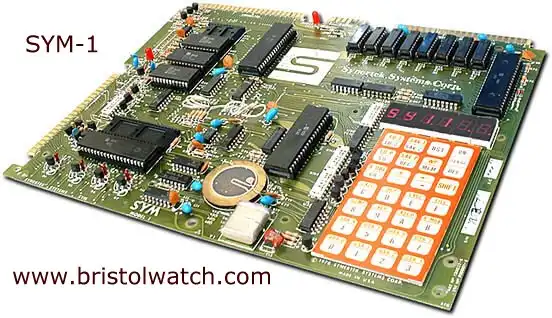
SYM-1 my second computer
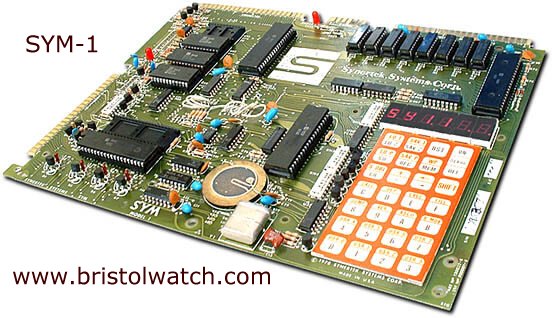
I purchased the SYM-1 around 1982. It still works today.
It has two 40-pin DIP sockets to install two, additional 6522 VIAs.
VIA stands for versatile-interface-adaptor.
This adds and additional 36 individually programmable I/O connections.
In addition, the two VIA sockets will work with the 6526 VIA used in the Commodore 64 computer.
To quote,
The SYM-1 was a competitor to the popular MOS Technology KIM-1 system, with which it was compatible to a large extent. Compared to the KIM-1, enhancements included the ability to run on a single +5 volt power supply, an enhanced monitor ROM, three configurable ROM/EPROM sockets, RAM expandable on-board to 4 kibibytes, an RS-232 serial port, and a "high speed" (185 bytes/second, the KIM-1 supported about 8 bytes/second) audio cassette storage interface. It also featured on-board buffer circuits to ease interfacing to "high voltage or high current" devices.
http://www.oldcomputers.net/kim1.html
- Quick navigation of this website:
- Basic Electronics Learning and Projects
- Basic Solid State Component Projects
- Arduino Microcontroller Projects
- Raspberry Pi Electronics, Programming
- Digital Circuits:
- Simple Schmitt Trigger SN74HC14 Square Wave Generator
- Introduction to RC Differentiator Circuits and Uses
- SN74HC14 Square Wave Generator uses SN7476 JK Flip-Flop
- Three Output Digital Pulse Generator
- Astable CD4047 Geiger Counter Power Supply
- CD4047 Monostable Multivibrator Circuit
- Basic TTL Tri-State Buffer Circuit Examples
- Tutorial NOR Gate SR Latch Circuits
- Tutorial NAND Gate SR Latch Circuit
- Tutorial OR-NOR Circuits Monostable Multivibrator
- Tutorial of XOR and XNOR Logic Gates
- LM555-NE555 One-Shot Multivibrator AC Power Control
- Arduino Projects Revisited Revised
- Programming ADS1115 4-Channel I2C ADC with Arduino
- Arduino uses ADS1115 with TMP37 to Measure Temperature
- Connect Arduino to I2C Liquid Crystal Display
- Arduino Reads Temperature Sensor Displays Temperature on LCD Display
- Arduino with MCP4725 12-bit Digital-to-Analog Converter Demo
- Videos
- Arduino with ADS1115 4-Channel 16-bit Analog-to-Digital Converter
- Arduino with MCP4725 12-Bit DAC
Videos:
My YouTube Videos on Electronics
Introduction to the Arduino Microcontroller
Part 1: Programming Arduino Output
Part 2: Programming Arduino Input
Part 3: Arduino Analog to Digital Conversion
Part 4: Using Arduino Pulse-Width-Modulation
Repost Arduino AC Power Control
- Comparator Theory Circuits Tutorial
- Constant Current Circuits with the LM334
- LM334 CCS Circuits with Thermistors, Photocells
- LM317 Constant Current Source Circuits
- TA8050P H-Bridge Motor Control
- All NPN Transistor H-Bridge Motor Control
- Basic Triacs and SCRs
Web site Copyright Lewis Loflin, All rights reserved.
If using this material on another site, please provide a link back to my site.