Arduino Projects Hobby Projects Tutorials
This section is a group of projects based on the Arduino micro controller. It's very inexpensive and easy to learn using a type of 'C' language. Note that I've used the Arduino Mini and their Bare Bones Kit from Modern Devices Company. I'm very pleased with both. If one can't solder then please buy an assembled kit. All information presented in these projects is free for anyone to use and there is no warranty of any kind.
These projects are for those with a two year degree, the garage tinkerer, ham operator, or even a kid in vocational school. Note that on Ebay there are a number of starter kits for sale by a number of individuals. These would be very good for those starting out from scratch. One will also need a PC and USB cable and/or USB to RS232 adaptor.
- PCA9555 32-Bit GPIO Expander with Arduino
- Arduino LCD Display using 74164 Shift Register
- Easy Driver Micro-Stepper Controller to Arduino
- Better Arduino Rotary Encoder Sensor
- Rotary Encoder Using Arduino Hardware Interrupts
- Arduino Controlling 74C164 Shift Register
- Arduino with MCP23016 I/O Expander
- Arduino
- Programming ADS1115 4-Channel I2C ADC with Arduino
- Arduino DC-AC Power Inverter
- 3-Wire MAX6675 Thermocouple ADC Arduino Interface
- Arduino Stepper Motor Drive Coil Winder
- TB6600 Stepper Motor Driver with Arduino
- Battery Charger related:
- Solar Panel Charge Controller Using Arduino Microcontroller
- Solar Panel Battery Charge Controller Using Arduino
- Solar Panel Battery Charge Controller Switching Circuit
- Solar Battery Charger videos:
- Solar Panel Battery Charge Controller Operation
- Solar Panel Battery Charge Controller Circuitry
- Solar Panel Battery Charge Controller Programming
- Tutorial Arduino Measure Current with ACS712 Hall Sensor
- Quick navigation of this website:
- Basic Electronics Learning and Projects
- Basic Solid State Component Projects
- Arduino Microcontroller Projects
- Raspberry Pi Electronics, Programming
Stepper Motors
- Unipolar Stepper Motor with a Arduino
- Considerations for Using Stepper Motors
- Connecting the Arduino to a L298N H-Bridge
- L298N Motor Controller Theory and Projects
- TA8050 H-Bridge Motor Controller
- Battery Charger related:
- Solar Panel Charge Controller Using Arduino
- Solar Panel Battery Charge Controller Using Arduino
- Solar Panel Battery Charge Controller Switching Circuit
- Arduino Interface MC3479 Stepper Motor Controller
- Arduino LCD Display with DS18B20
- Arduino LCD Display with DHT11 Sensor
- Arduino with MM5451 LED Display Driver
- Arduino MAX7219 Operates 8X8 LED Matrix
- Arduino RTC Clock MAX7219 LED Display
- BCD Conversion with MAX7219
- Hatching Chicken Eggs with Arduino
- Arduino TMP37 Temperature Sensor
- Arduino TMP37 Temperature Sensor Tutorial
- The following use obsolete parts and are kept as a reference.
- Testing the Keyes IR Sensor Module with Arduino
- Arduino to MCP23016, LCD Display
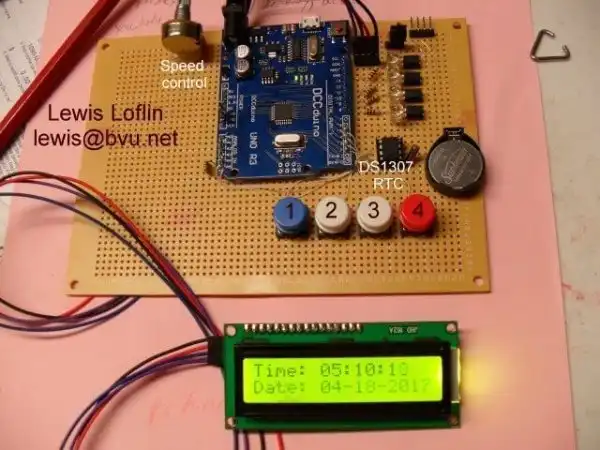
- Time-Date with Arduino, LCD Display, DS1307 RTC
- Controlling Driveway Lights with the Arduino
- TSL230R Light to Frequency Converter
- Arduino DS1307 Real Time Clock
- Arduino with 24LC08 Serial EEPROM
- MC3479 Stepper Motor Controller with Arduino
Web site Copyright Lewis Loflin, All rights reserved.
If using this material on another site, please provide a link back to my site.